Summary of Key Findings
We performed three contextual inquiries that incorporated the perspectives of a stakeholder in WCMA, a student who works at WCMA and therefore has a considerable amount of knowledge on WCMA’s collection, and a first year student who had never visited the museum. The contextual inquiries took aim at dissecting how a museum is set up to engage with its visitors and operate as a physical space versus how museum visitors interact with, navigate, and experience the museum. Each visitor, employee, or mix of the two brings their own perspective not only to WCMA as an institution, but also to the art within its walls. Our contextual inquiries gave insight into the similarities and differences of these users, showing that optimizing the experience for visitors starts with blending all three parties’ perspectives. Some interviewees focused more heavily on the artwork, some on the physical space, and others on the flow from piece to piece and exhibit to exhibit. To optimize a visitor’s experience, we will focus in on the factors that make WCMA unique as a museum and how personal preferences lend themselves to overall experience, yielding a design that best serves each user as well as WCMA collectively.
Design Research Goals, Users, and Stakeholders
For our first three contextual inquiries, we chose three different Williams community members, each with varying levels of familiarity with the museum. RL is a student that is not at all familiar with WCMA, but has worked at a museum before. NS is a student who has worked at WCMA and is very familiar with it as a result. NP is a full-time staff member at WCMA who is both intimately familiar with the art and the museum’s visitors. We anticipate our typical user will be a visitor who may or may not be familiar with WCMA’s collection.
RL is first year student who is not familiar with the works of art in the WCMA collection or the layout of the museum, however she is familiar with museums more broadly as she has worked in one previously. She represents a user who is unfamiliar with the physical space, but has an idea of how to approach the museum as a whole. Her prior job had been to take museum tours and evaluate them based on a number of criteria. This means that RL has a strong background in understanding the flow of museums, features of the space, stylistic preferences of curators, and overall knowledge on various types of art. I asked her to walk around the museum as she would any other, point out any features she found interesting, curious, or that stood out. In following her around I asked her about some of her behaviors, choices to look at certain are, and path taken. She had deep insight not only the experience as a visitor, but also as a knowledgeable member of the museum community. She focused on the physical placement of pieces in the room, lighting, and flow between exhibits. She also described her personal preference on how pieces and exhibits were described in words either on the wall or small plaques. RL was an invaluable interviewee as her insight was able to blend the step by step process of navigating a museum while also keeping the big structure of the museum in mind.
NS is a senior Art History major at Williams College who spent a summer working at WCMA and now continues to work part time for them. She is an interesting subject because she is a stakeholder of the museum as both a visitor and an employee. We met in the WCMA lobby, and I asked her to just wander the museum exactly as she normally would. She led me around the museum, and we discussed different aspects of her visit as the arose. At the end of the inquiry, we sat in the Reading Room on the second floor, as NS always does, and discussed some of the insight she has as an employee of the museum. While she represents a visitor intimately familiar with the museum, and thus without need of guidance, she did offer good insight into the knowledge other visitors come in with, such as the fact that many people know little to nothing about the museum’s public art collection or architecture of the building itself.
NP is a stakeholder in WCMA with a vested interest in visitor engagement. Her job is focused on academic and public engagement; as a result, she is an expert on these topics at WCMA. We met in her office where I asked her a series of probing questions about her process and about the kinds of things she thinks about at WCMA, while visiting other museums, and while designing projects and programs for visitor engagement. I then asked her to take me on a typical walk through the museum and she suggested that she bring me on a tour as though I were a visitor that she was introducing to WCMA’s spaces and the many programs there that facilitate visitors’ interactions with the collection and space. NP expressed how WCMA is meant to be a space where visitors of all kinds can learn and focused on facilities and programs such as the Rose Gallery, the Art Department offices, the student-selected installation of Our Love is Bigger Than an AIDS Quilt, and the Object Lab. I asked probing questions about how these programs relate to the collection as a whole and how they are made to apply to both students and the general public alike, to which NP was very responsive and informative regarding steps taken by WCMA stakeholders to improve engagement with the general public as well as with students. When prompted, NP also discussed the problem with wayfinding at the WCMA entrance and different strategies employed by the museum to combat this problem such as a section of wall with arrows pointing to different parts of the museum and ideas for an interpretive map of the museum and collection.
Results and Themes
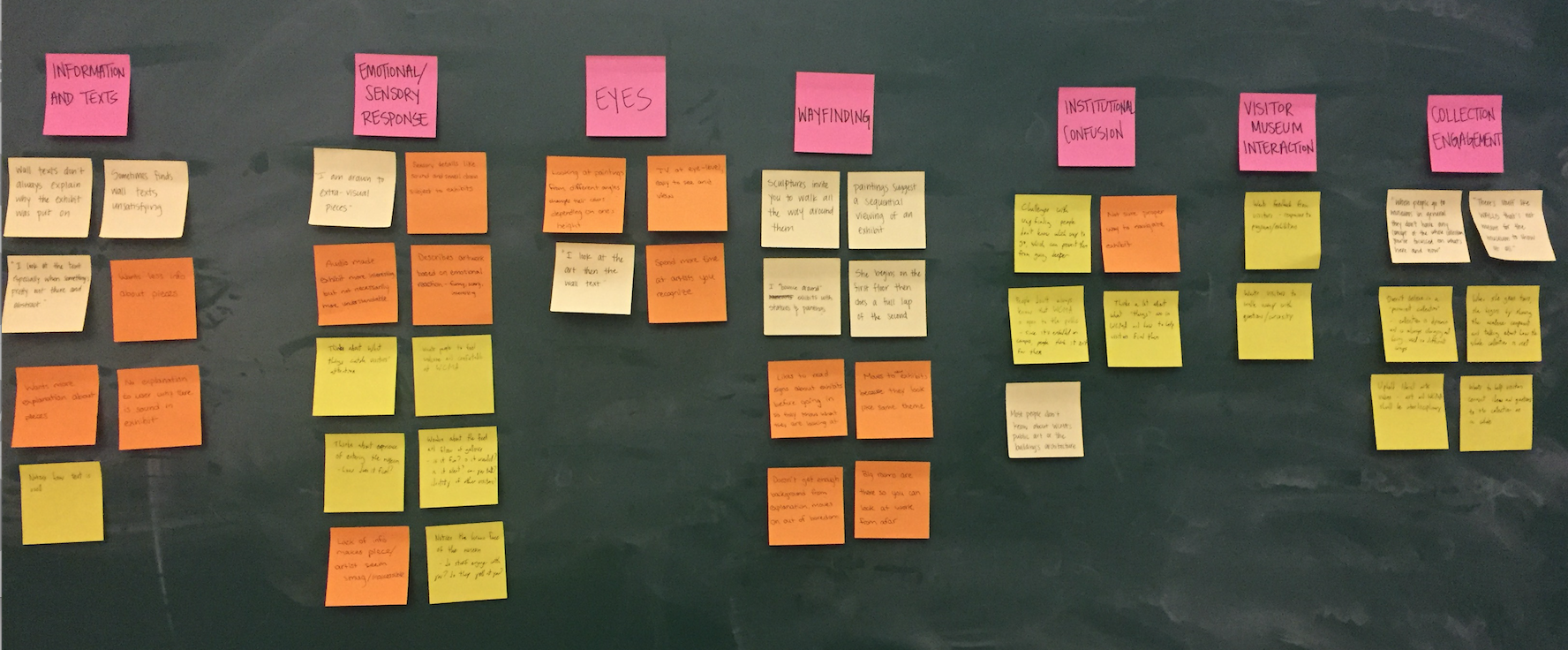
From our contextual inquiries, we have gained increased insight into the ways that museum visitors find their paths through the space, react to and learn from objects, interact with information, and develop curiosity about and relationships with objects based on their own personal interests and experiences. We learned that sometimes they feel overwhelmed by choices and content and that other times they wish there was more for them to see, hear, or even smell.
Themes: Information and Texts, Emotional/Sensory Response, Eyes, Wayfinding, Institutional Confusion, Visitor Museum Interaction, Collection Engagment
One crucial theme is that of wayfinding. WCMA has many possible paths from its entrance and infinitely more through the galleries. There is no map and it can be difficult to decide where to go when a visitor’s hierarchy of needs may become inundated by curiosities inspired by the saturation of information and options at WCMA. This can lead to another observed theme that we have dubbed institutional confusion – a negative part of user experience where visitors become confused about where to go, what they can do, and/or what kinds of things are available at WCMA. Within the exhibitions themselves, visitors often find themselves wandering aimlessly between and around freestanding works and objects mounted on walls. Related to this theme is the question of where to look – wayfinding for one’s eyes is just as crucial of a choice in a museum; this was demonstrated to us when both Williams students, each with vastly differing levels of experience with WCMA, described the angles, duration, and order of viewing that they employ when gazing at objects. In our product design, it will be important to consider how we can help users narrow down their choices so as not to feel overwhelmed by the museum while still affording the opportunity to make choices and have fun making them. A user should be able to decide and interpret their own path through the museum – our design aims to make these decisions fun and exciting, rather than intimidating.
The other themes we observed in our inquiries related to visitor interaction with the museum and its collection – what kinds of emotional and sensory reactions they felt, how they felt they were able to engage with the broader collection rather than just the works on display, and their reactions to textual information. Our expert participant, who works in visitor engagement at WCMA, described how she always notices text and how visitors react to it, as well as noting that she and most of WCMA’s visitors are drawn to works that are more stimulating to the senses whether due to smell, sound, or visual composition. She also described her desire for visitors to respond to programs and exhibitions as well as ask questions about them. Our student visitor participants echoed these themes in their interactions with the exhibitions by commenting on the seeming absence of the “rest of the collection” and describing their reactions to particularly “eye-catching” works and text that they found at times insufficient and at other times excessive. When considering affordances and signifiers for our design, we must be cognizant of how text operates in the context of art museums and utilize the natural attraction towards works that stimulate the senses to create more opportunities for visitors to engage with not only the works on display but the collection as a whole.
Task Analysis
Who is going to use the design?
Our design is available and accessible to any and all users of a museum, including all age ranges and persons with varying degrees of museum or art expertise. While owning a smartphone will enhance the experience, it is certainly not necessary.
What tasks do they now perform?
Currently, our users visit museums. They walk in the front doors, choose a direction to move in, then begin their traversal of the museum. As they move through the exhibits, they wander around the rooms, looking at the art, pausing longer at those pieces that pique their interest. Given that WCMA is small, our users generally leave after they’ve seen the whole thing, and notably don’t explore WCMA’s virtual collection or gain insight into the curators’ intentions.
What tasks are desired?
The desired tasks are:
- Discovering works that otherwise would have been overlooked
- Conveying personal artistic preferences so the product can tailor itself to each user specifically
- Learning about the curator’s perspective and vision for the exhibit
- Continued engagement with the users favorite or most memorable pieces
- Learning more about the collection as a whole, most notably introduction to the virtual collection
- Gaining agency in one’s museum experience
The general task then, would be to create a route that brought the visitor to all the pieces they were likely to enjoy. This includes, identifying the user’s preferences, directing them to pieces that match said preferences, and introducing them to the curators’ perspective and WCMA’s digital collection.
How are the tasks learned?
The competence to achieve the existing tasks is innate within each visitor, they simply need to be given the tools to do so, which our product will do. The new tasks are learned through guidance built into the product. As the user engages with the product, they will be continually prompted what to do, such that they don’t have to go out of their way to learn how to perform the tasks, and ideally might not even know they are learning. Additionally, there has to be a means for the user to learn that the product is available to them. This could be achieved through in museum advertisement, as well as publicity on WCMA’s website and social media platforms.
Where are the tasks performed?
All of the tasks will occur at various points throughout WCMA. Primarily, these locations will be kiosks in areas where there is not other art on the walls; however, there is also some functionality to be performed on a mobile device in the exhibits.
What is the relationship between the person and data?
The person should relate to data as though they were reading a map or guidebook meant to inspire and personalize a new or repeated experience – that is, the person will use the design to help them navigate not only WCMA’s hallways but also the broader collection as a whole, including objects not on the walls. Stakeholders will find that data provides meaningful insights into the interests, behaviors, movement, curiosity, and engagement of museum visitors.
What other tools does the person have?
The person’s other tools include the publicly available WCMA Collection API, which represents a virtual cataloguing of almost the entirety of WCMA’s collection and includes a search function. In lieu of a museum map, visitors might notice a wall by the entrance with arrows pointing to the different parts of the museum (offices, Object Lab, restrooms, exhibition galleries, etc.). Additionally, the person may approach any staff members at WCMA, including the host at the front desk, to ask any questions they may have or simply to express their interest or curiosity in the museum and its collection.
How do people communicate with each other?
Communication at museums occurs verbally and non-verbally – visitors communicate their feedback, curiosities, and overall engagement with objects and spaces through their interaction and movement while stakeholders communicate through iterative projects that attempt to gauge public response. In our design, people can communicate their artistic preferences and share there completed routes.
How often are the tasks performed?
The tasks are performed throughout a user’s visit to the museum. They begin upon arrival when the user opens their app to track their location, and then continue as they move through the exhibits and stop at the kiosks in between each.
What are the time constraints on the tasks?
The time constraints for the tasks would generally be the duration of the visit to the museum. The only extent to which the time restraints of the tasks would extend beyond the visit is when the user brings home their souvenirs or chooses to save or share their route.
What happens when things go wrong?
In the case that things go wrong, the user could return to a kiosk where there would be a help page that could offer troubleshooting tips. Additionally, the user could reset their trip or simply explore the museum with only one or none of the platforms.